![]() |
| Alaska Highway - scale of the immensity & extremes the builders of this road had to face |
Showing posts with label Classroom Ideas. Show all posts
Tuesday, August 28, 2012
On the Road Again
Tuesday, August 7, 2012
Centers at the Beach
Tide Pools:
Let's start with tide pools, they are a very simple contained ecosystem at low tide, that at high tide become part of the larger ecosystem - the cove, or even broader, the ocean. Studying a tide pool is like putting a microscope on the bigger happenings of the ocean. Focusing on how each of the organisms interact with one another illustrates how concepts such as food chains, symbiotic and parasitic relationships work.
River Formation:
Looking to runoff on beaches or even after a storm on the side of the road one can see the life story of a river. What takes thousands of years can happen in hours, even minutes. Learners can watch streams of rainwater begin to meander and braid themselves. Watching what glacier melt has taken so long to do and which can only be seen from an airplane on the larger scale. Simply taking bucket of water and releasing at the top of the beach allowing the water to head downhill toward the ocean can usually reenact the phenomena. Taking a video camera and creating a movie back at home or school would be a great way to integrate media into the lesson, by creating a documentary about the life cycle of a river.
![]() |
| A braided river from the air. |
| Rain run off on the beach |
While at the beach for the day take measurements of the waterline to determine how much the tide changes. This is easier to mention when the tide is receding than when it is coming in because you can make lines in the sand that don't get washed away. Have the students use a tide chart before hand to figure out when the best day for the field trip should be.
Materials:
Some of the materials you may need for a day of centers at the beach are:
- tide chart
- field journals to record data/observations, draw diagrams and take notes etc...
- color pencils to sketch observations
- measuring tape for measuring tide change
- buckets & scoops to collect specimens and samples
- magnifying glasses
- portable microscopes if available or you can take samples back home or to school
- marine life field guides for identifying species
- camera with video
- clip boards
- towels
What other activities or centers could you do during a field trip to the beach?
Monday, August 6, 2012
Salmonberries - Field Notes from Kodiak
My family and I have been thoroughly enjoying our extended stay in Kodiak this summer! We've explored mountains, beaches, rivers and the ocean. I was worried about not being able to go berry picking this year in my favorite spot back home outside of Anchorage. Kodiak has proved to be even better! I may not be able to move back!
My favorite part of the year is always berry picking season! It's in my blood, literally. My father is half Finnish, making me a quarter and the Finns are avid berry pickers as their climate is very similar to Alaska. Even those who immigrated to the US, kept up this tradition. My great grandmother owned a blueberry farm in southern New Hampshire. My grandfather made sure to have a bounty of blueberry bushes on his own property. My dad grew up picking berries at my Great Grandma Liimatainen's farm.
Alaska is a land where people take the utmost pride in their ability to subsist of the land. So be careful when you ask someone where their favorite blueberry spot is... they may lead you astray. Like favorite hunting grounds and fishing holes, we guard our berry picking spots with great secrecy, only to be shared with family or close friends.
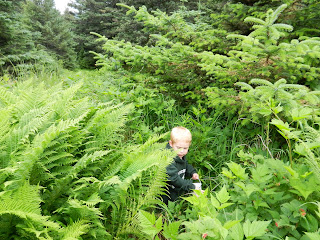
| My little forager. |
Due to the cold, very snowy winter, they were a little later in their ripening this year. While my family was on one of our almost nightly walks on the docks, checking out the fishing boats and more importantly the new sailboats in from all over the world, I overheard a funny conversation between two burly fishermen getting their nets ready for their next run. They were cursing up a storm, when one stops and says "Hey what's up with the salmonberries this year? But this f*&%$ing time last year I was f#%^@ing making jam!" It seemed so comical to me that such a rough and tumble guy would be swearing and talking about one of the most historically domestic tasks. Even cussing, giant, weathered men have a soft side.
While the fisherman like salmonberries, so too do many of the birds. It is amusing to watch them after they've gorged themselves on the fruit, then try to take off and fly, markedly larger than when they had first landed. Flying much lower to the ground they take a while to gain altitude.
While at storytime at the local library, the children's librarian read a great story about berries, harnessing the many connections and experiences the children have with them this time of year. The craft to go along with the story was to make a berry bucket, complete with bells, so you can easily locate your child and in Kodiak hopefully warn the bears of your presence, as they love berries too. If only Sal in Blueberries for Sal had a berry bucket with bells... ah but then there wouldn't have been a good story to tell.
Here are the materials needed for the bucket:
- a yogurt container with lid
- hole puncher
- yarn
- pipecleaners
- bells
- stickers to decorate
Monday, December 12, 2011
Lessons from Professor Snowman
My son has really wanted to build a snowman ever since the first snowfall in early November. The problem was it was too cold. Not too cold for us to be outside, but too cold for the snow to stick together. He wanted to know why.
Now my son is just shy of 3 years old. We aren't going to go really deep with this, but there are some ways we can work to develop an understanding of the concepts which answer this question. Inquiry is about the learner discovering, not about the teacher telling. The solution to this problem won't be found in a day, in fact, for this particular inquiry he won't know the real root of the answer for years. Knowledge builds and spirals on itself.
We start off by simply applying a very basic scientific method approach. Each day we look at the thermometer and I read the temperature to him. I ask him how cold it feels outside. Warm, chilly, cold, really cold or freezing? Then we try to make a snowball and discuss the texture and weight of the snow. Is it light and fluffy or heavy and clumpy. Does it stick together or fall apart? I wait to see if he draws any conclusions... it is a pretty sophisticated concept for a toddler to correlate temperature with snow conditions, but we're building the blocks for better understanding later.
With my 6th grade students we would start at a very different place. They will be able to read the thermometer themselves, for starters, but they quickly, if they haven't already in their lives, correlated temperature with snow conditions, especially if they are into skiing which many kids in this region are. Though with my particular group skiing is a luxury their families can't afford. They do however have prior knowledge to draw from, having years of snowball fighting and snowman building experience. They should also have some understanding of states of matter. Now we can start to deepen their comprehension of the concepts at play here. Having really worked with my students on how to use references they can start research in the library and the internet. They can also start to conduct experiments: recording data and observations. Date, time, temperature, snow quality. Eventually between research, experimentation, and a little guidance they are able to conclude that there exist subtleties between states of matter. You don't just go directly from ice to water. There are shades of grey in between. Some of the kids have discovered through their research how the molecular structure of water changes. This is when I see if I could get a local expert in. The University of Alaska, Anchorage and Alaska Pacific University are right here - a wealth of resources for any educator. I seek out a glaciologist and bring her in to help us put all the pieces together.
There are many extensions and culminating ways you can use to put this new found understanding to use and allow the students to apply their knowledge and for teachers and parents to assess the accuracy of the information gained:
- Have students keep a journal recording their daily investigations, research or experiments. Journals are a great way to tap into many different intelligences, as Howard Gardner would say. Students who are visual can draw and map out their findings while students who are very literal can do more writing.
- A great cumulative way to prove their understanding of their path to discovery is to create a flow chart, mapping their way from their starting point - the question to their conclusion.
- The best test of what a student has learned is if they are able to explain the concept acquired in their own words - a wonderful way to do this is to explain the process to a younger audience. I often have my 6th grade students write stories or lead experiments for their 2nd grade reading buddies.
Sunday, August 28, 2011
Blueberry Buddies and Lessons from the Land
Lia (from Skedaddle) and I packed up our boys this morning and made a trip to a favorite top secret blueberry location. Like hunting grounds, fishing holes and gold claims, favorite berry crops are kept between close friends in Alaska. The boys did all the hiking on their own. After the adventure, in both houses, pie became the fate of the wild grown alpine fruit. Out of ALL the blueberry recipes in my cookbook, The Joy of Blueberries: Natures Little Blue Powerhouse, pie always seems to win... well it ties with the blueberry coffee cake.
- Estimating - estimate how many berrys are in your container then count them.
- Volume - pour berries from a smaller container into a larger one
- Ecology - food chain, paying attention to where the berries are found on the mountain side - are they near streams? high in the rocky areas? low in the boggy areas? Is this habitat to other creatures?
- Topography & Geography - bring a compass or a gps device to record your coordinates, pay attention to the terrain and elevation gain as you hike.
- Measurement & Fractions- baking
- Democracy - let the students or members of your family vote on the fate of the berries... pies, smoothies, muffins etc...
- History - in my family's case blueberries are an important part of our history, my great-grandmother owned a blueberry farm in New Hampshire, as did many other 1st generation Finnish Americans. Berry's are also a part of the subsistence culture of Alaska from it's Native peoples to the gold miners fighting off scurvy in the long winter months.
- Literary connections - as I mention in an earlier post Blueberries for Sal, by Robert McCloskey is a favorite in our house. Blueberry Shoe, by Ann Dixon, a local author is another.
- Nutrition - There are many benefits to eating berries - antioxidants and fiber are just the beginning.
Saturday, August 20, 2011
Art & Nature
Andy Goldsworthy is a world renowned artist, who's trademark is natural installations. These are some of the gorgeous books of photographs depicting his work. There is also a great documentary where he discusses his creations and you can watch him manipulate the natural world till he creates a final product. Creating natural installations after studying the remarkable artist is an amazing activity for students at any age. It is also a great lesson to do multiple times with a class over the seasons.
Saturday, July 30, 2011
Self-portrait in the Land
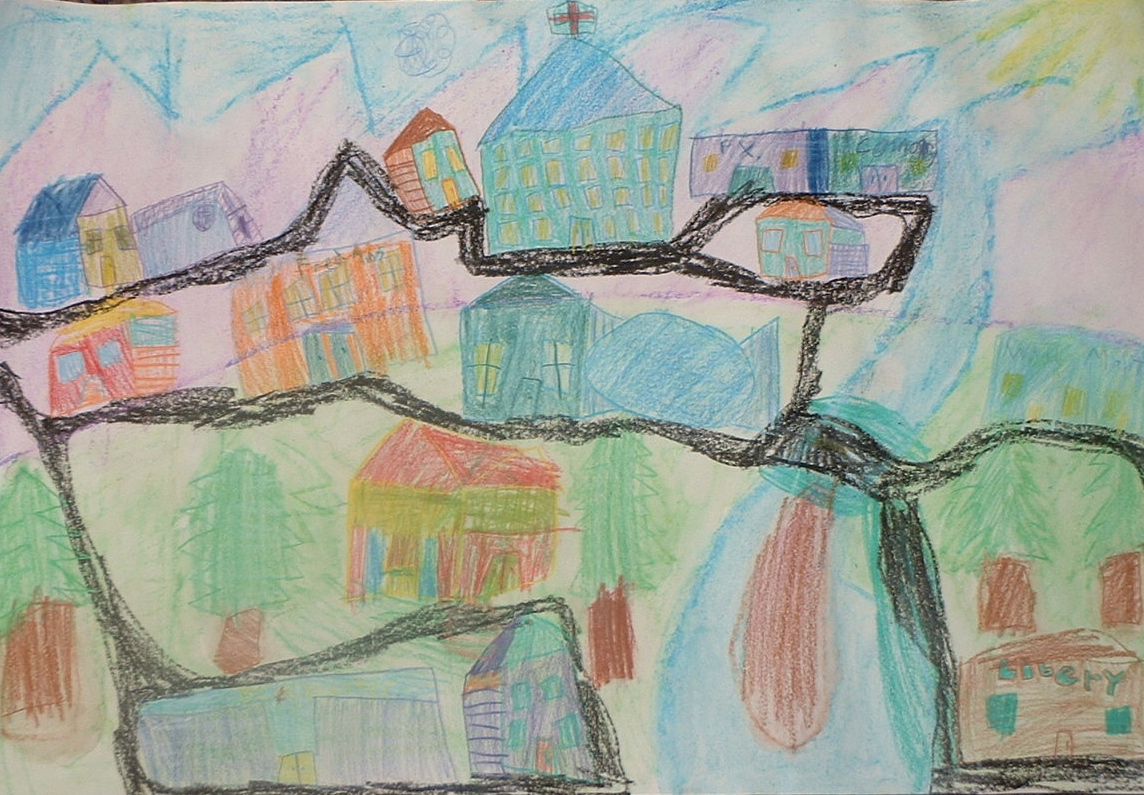
Draw or paint a landscape self-portrait of yourself - depict your town with all the local landmarks, geographical or architectural, that represent you. If I were to paint a landscape painting that represents me I would include the mountains because I love hiking, the school I used to work at, my house, the hospital where my son was born, the grocery store where I get my food, the library where we go to storytime, the beach, an airplane because that connects me to my family back East etc... Extensions for the lesson include having the students guess who's painting is whose and writing a key explaining what each landmark is and why it was included.
Local Fare
In the home or classroom: make a meal of traditional local fare. Research why it is a favorite in your neck of the woods, where the ingredients come from. Is it a favorite because there exists a concentration of people from a certain nationality in your area, is the produce grown or harvested there or does it grow naturally?
Cooking is such a great learning opportunity to involve your children in concepts such as volume, measurement, fractions, states of matter, physics and chemistry can be experienced in context. Not to mention they also get to take in sensory information, use descriptive language and just have good old fashioned family fun!
Traffic Jam = Math in Context
Planning for the upcoming school year? Every student wants to know at some point how learning this math is relevant to their lives. Here's an activity that is fitting for urban and suburban areas. Have the students study traffic patterns. Pic an intersection or a few to study. Invite a traffic planner in. Discuss how light signal timing works and explore the formulas involved.
Friday, July 29, 2011
Start a Local Library
In the home or the classroom - start a Local Library. Collect books written by local authors, set in your region or illustrated by local artists. We have a bi-coastal library in our home. Books from New England and Alaska. It's a powerful thing to share your "place" with your children too. We love reading Good Night Rhode Island and talking about where Mima, Pepe, Auntie, Uncle and cousins live.
Subscribe to:
Posts (Atom)